

Crypto-native casino review
Stake has operated since 2017 as a crypto-native casino built around direct digital-asset payments, a large third-party game catalogue, in-house Stake Originals and a multi-tier VIP system. The practical experience is shaped as much by network choice and account checks as by the games themselves.
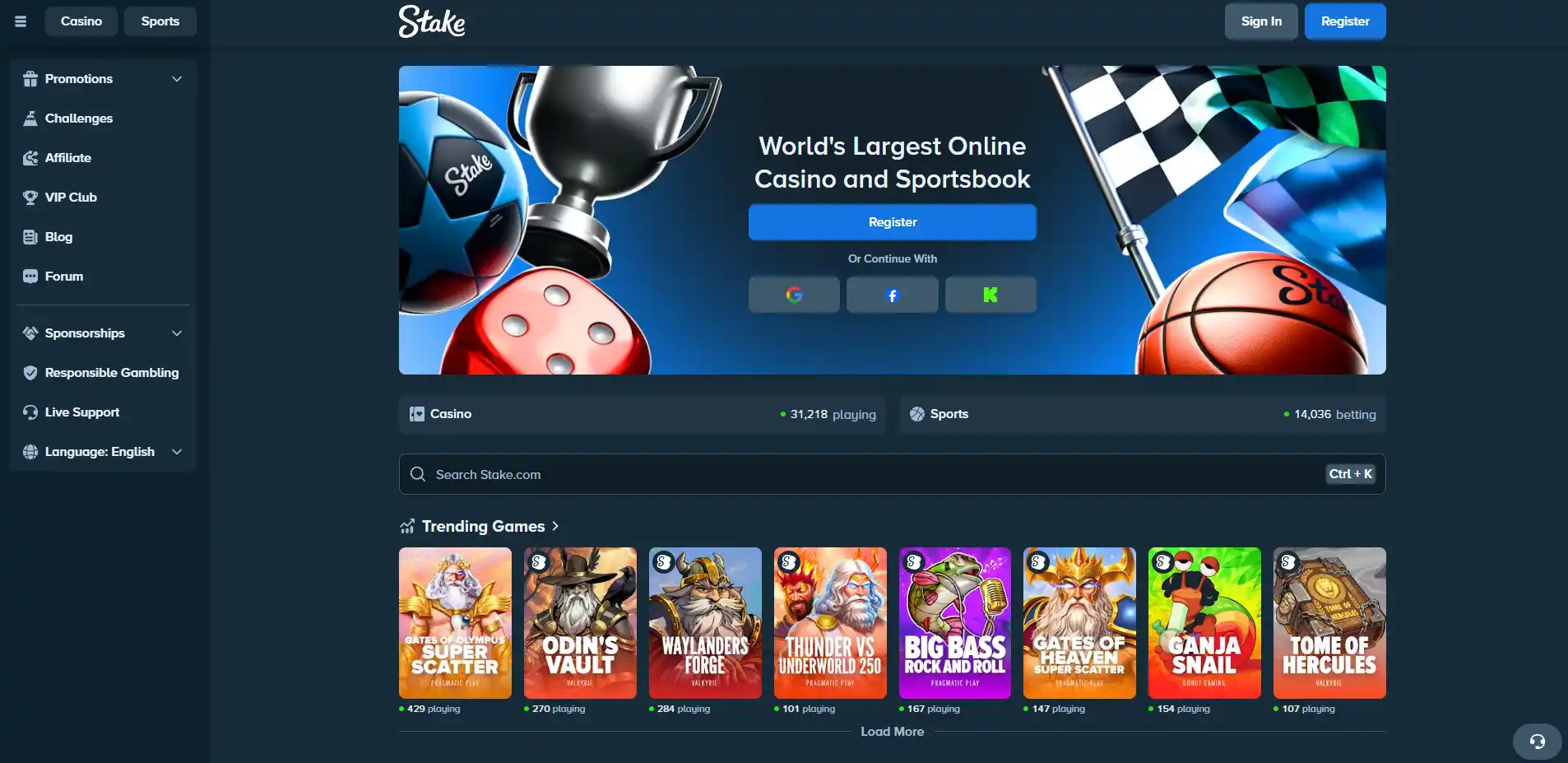
Stake at a glance
The defining pattern is consistent across the product: crypto is the payment rail, the casino catalogue is broad, and rewards are concentrated in the VIP structure rather than a conventional first-deposit package.
- Operating since2017
- Crypto support20+ assets
- Game catalogue5,000+ games; some counts exceed 6,000
- Game studios100+ providers
- OriginalsDozens of proprietary provably fair games
- Welcome postureNo standard welcome or no-deposit package
- 20+supported cryptocurrencies
- 100+game studios
- 3.9/5Trustpilot score
Stake was founded by Ed Craven and Bijan Tehrani after work that began around provably fair Dice. That origin still shows in the casino: third-party games sit alongside a distinct in-house Originals catalogue rather than replacing it. Stake also operates a sportsbook alongside the casino.
For a closer look at the operating and access context, the separate Stake license section handles those questions without mixing them into game, payment or rewards analysis.
A crypto-first structure changes the workflow
Stake is not simply a conventional casino that happens to accept Bitcoin. The supported list includes BTC, ETH, LTC, DOGE, SOL, TRX, XRP, BCH, BNB, USDT, USDC and POL, with total support above 20 cryptocurrencies. Traditional bank deposits are not the core payment route; fiat is handled through crypto-purchase partners rather than standard casino banking rails.
Asset choice comes first
Before a deposit, the reader has to decide which supported asset to use. That choice affects which wallet balance is moved and which network must be matched in the payment flow.
Network choice is operational, not cosmetic
ETH maps to ERC20, TRX to TRON, SOL to Solana, POL to Polygon and BNB to BEP20. USDT can use ERC20 or TRC20 among other routes. A network mismatch can make a transfer difficult or impossible to recover.
Crypto value can move while you play
Casino balance decisions and asset-price movement are separate risks. A gaming result can be positive while the crypto asset itself moves against the reader in fiat terms, and the reverse can also happen.
Stake’s crypto-first model is most straightforward for readers who already understand wallet addresses, network labels and irreversible blockchain transfers. The casino interface cannot remove those external transfer mechanics.
The dedicated Stake payments guide breaks down assets, networks, deposits, withdrawals and fee handling in more detail.
Crypto payments shape the experience
Deposit minimums are not best treated as one universal dollar figure. The practical threshold depends on the coin and network shown in the live payment dialog. Withdrawal handling is clearer: Stake does not impose platform daily, weekly or monthly crypto withdrawal caps, and it does not add its own crypto-withdrawal fee; the network fee still applies.
Crypto withdrawals are near-instant after approval; typical observed completions run from around 15 minutes to two hours, while manual review can extend the process to as much as 24 hours. Those intervals are not guaranteed, because account review and blockchain conditions can alter the path.
| Payment factor | Stake detail | What it changes for the reader |
|---|---|---|
| Supported assets | 20+ cryptocurrencies | Wallet and asset selection become part of the deposit process. |
| Networks | Multiple routes for some assets | The network must match on both sides of a transfer. |
| Deposit minimum | Depends on coin and network | The live payment dialog is the practical reference point. |
| Withdrawal caps | No platform daily, weekly or monthly crypto caps | The main constraints shift toward account checks and blockchain handling rather than platform period caps. |
| Withdrawal fee | No Stake platform fee; network fee applies | Transfer cost is linked to the blockchain route rather than an added casino withdrawal charge. |
- Choose the asset in the payment interface and confirm it is the same asset held in the sending or receiving wallet.
- Match the network exactly. A familiar ticker such as USDT can exist on more than one blockchain route.
- Re-check the destination address and network before broadcasting because blockchain transfers are generally irreversible.
- For withdrawals, allow for approval or review before the transaction reaches the network.

Crypto transfer check
Match the asset and network before a transfer
A crypto transfer succeeds only when the asset and network match on both sides. Use the selector to check the mapped route before copying an address or sending funds.
Single mapped route
How this works
Selected asset + selected mapped network + transfer direction = route-match guidance. The result checks that the same network is used in the Stake payment dialog and the sending or receiving wallet. It does not estimate transfer fees or speed.
USDT can use ERC20 or TRC20 in this explorer. Other routes may appear in the live payment dialog, so re-check the displayed network before sending.
18+. Gambling Therapy provides international support. Check the helpline and gambling laws in your own country. Crypto prices can move sharply, and blockchain transfers are generally irreversible.
The game catalogue combines major studios with Stake Originals
The casino carries more than 5,000 games, while some published counts put the total above 6,000. Provider coverage exceeds 100 studios and includes Pragmatic Play, Evolution, NetEnt, BGaming, Hacksaw Gaming, Play’n GO, Relax Gaming and Nolimit City. That breadth matters because it spreads the catalogue across slots, table games, live dealer products and game-show formats instead of depending on one software stack.
Third-party catalogue
- 100+ studios across the catalogue.
- Live casino supplied by Evolution and Pragmatic Play Live.
- Roulette, blackjack, baccarat and live game-show categories are present.
Stake Originals
- In-house titles include Dice, Mines, Plinko, Crash, Dragon Tower, Keno, Limbo, Blackjack, Roulette, Baccarat and Video Poker.
- The Originals catalogue changes over time, so a single fixed total is not useful.
- Stake Originals use provably fair outcomes that can be checked by the player.
Provably fair does one specific job: it lets a player check the relationship between cryptographic inputs and a game result. It does not eliminate house edge or variance, and it does not turn a negative-expectation casino game into an investment. The deeper provably fair guide explains that distinction, while the Stake games section maps the broader catalogue.
Catalogue size alone does not tell a reader whether a particular session will fit their preferences. Third-party live tables emphasize real-time pacing and dealer interaction, while Originals such as Dice, Mines, Plinko and Crash use compact mechanics that are easier to repeat quickly. The useful comparison is therefore category, provider and game mechanic rather than a headline total. A catalogue can be large while an individual player still uses only a narrow slice of it.
Fast sign-up does not mean permanent anonymity
Stake supports a quick crypto-oriented registration flow, but identity and address documents can be requested at higher verification levels and around withdrawals. Verification can also be requested at other points, and withdrawals can be restricted until the requested checks are completed. Full anonymity should therefore not be assumed.
Initial access
Registration is designed to be fast and crypto-oriented.
Possible checks
ID and address documents can be requested.
Withdrawal effect
Requested verification can affect when a withdrawal is released.
Mobile access
Mobile web and PWA-style access are available; native-app availability should not be treated as universal.
A transfer can be technically correct and still wait on account review. Readers moving a large balance should treat wallet/network checks and account-verification status as separate parts of the withdrawal process.
The Stake account guide focuses on verification and mobile access, and the withdrawal guide separates approval time from blockchain transmission.
Rewards lean on VIP, rakeback and recurring benefits
Stake does not use a standard welcome or no-deposit package as its default acquisition model. Rewards are concentrated in the VIP system, where Bronze is the entry level for rakeback and the reward rate rises with level. Weekly and monthly bonuses are part of the programme, reloads appear at higher tiers, and upper-level players can receive personalised support from a VIP host.
| Reward element | How Stake uses it | Reader takeaway |
|---|---|---|
| Standard welcome package | Not the default model | Do not assume a conventional deposit-match offer is waiting at sign-up. |
| Rakeback | Begins at Bronze and increases with level | Reward value is tied to sustained activity rather than a one-time entry offer. |
| Weekly and monthly rewards | Part of the recurring VIP structure | Timing and eligibility matter more than a single headline bonus. |
| Reloads and VIP host | Associated with higher levels | Upper-tier benefits depend on account progression and activity. |
Stake does not run a standard welcome package. Any live code-based promotion should be read on its own current terms rather than treated as a permanent platform feature.
Readers comparing reward mechanics can use the Stake bonus guide for the promotion structure and the Stake VIP guide for progression, rakeback and recurring rewards.
Recurring rewards also change how bonus terms should be read. A one-time deposit match can be judged mainly on the amount and wagering requirement; a VIP-led system depends more on how activity accumulates over time, which benefits unlock at a given stage and whether the player would have wagered that volume without chasing the reward. Reward value should stay secondary to loss limits and session discipline.
Trust signals are mixed rather than one-dimensional
Casino Guru lists a 7.9 Safety Index for Stake, labelled “Above average.” Trustpilot shows 3.9/5 from roughly 11,724 reviews, with a sharply split distribution in which most reviews are five-star while a substantial minority are one-star. Those two sources measure different things, so neither should be treated as a complete substitute for payment, account and dispute checks.
The brand’s history also includes a 2023 wallet incident involving about $41 million. Player funds were compensated after the incident. The incident is relevant because crypto operators depend on wallet infrastructure as well as casino software; compensation after an incident does not make operational security irrelevant, but it does provide context on how the event was handled.
Independent index
Casino Guru lists Stake at 7.9 on its Safety Index, providing a structured third-party signal.
Large review base
Trustpilot’s 3.9/5 score comes from roughly 11,724 reviews, so the aggregate reflects a large amount of user feedback rather than a handful of comments.
Operational history matters
The 2023 wallet incident shows why custody and payment infrastructure belong in a casino risk review alongside games and rewards.
Ratings and reviews also work best as signals rather than shortcuts. An aggregate score can show the broad direction of user sentiment, while an index can apply a structured methodology, but neither predicts how a specific withdrawal or support interaction will unfold. Combining those signals with payment mechanics, account checks and incident history produces a more useful picture than relying on one number.
Readers who want the operator and access context separated from these product signals can continue to the dedicated license section.
Practical controls reduce avoidable crypto errors
Most preventable mistakes in a crypto casino happen before a game round begins: the wrong network is selected, an address is copied incorrectly, a withdrawal is requested before account checks are complete, or a reader assumes a promotional term that is not part of the standard offer. A short operating routine reduces those errors.
- Confirm the selected asset and blockchain network in both the wallet and Stake payment dialog.
- Use the current payment interface for the applicable deposit threshold rather than relying on a universal minimum.
- Treat withdrawal approval and blockchain confirmation as separate stages.
- Read any code-based bonus terms in the live offer context instead of assuming they define Stake’s standard welcome policy.
- Expect ID or address checks to be possible, particularly when withdrawing.
- Separate game risk from crypto-price risk when deciding how much value to leave in a volatile asset.
Provably fair verification is useful for checking a specific Originals result, while payment safety depends on wallet, network and address discipline. They solve different problems.
Questions readers usually ask
What makes Stake different from a conventional online casino?
Stake is crypto-native. It supports more than 20 cryptocurrencies, uses blockchain networks for casino payments, combines a large third-party catalogue with Stake Originals, and puts much of its rewards structure into VIP, rakeback and recurring bonuses rather than a standard welcome package.
How fast are Stake withdrawals?
Crypto withdrawals are near-instant after approval. Typical observed completion times run from around 15 minutes to two hours, while manual review can extend the process to as much as 24 hours. These are observations, not guaranteed completion times.
Does Stake charge a withdrawal fee?
Stake does not add its own crypto-withdrawal fee. The relevant blockchain network fee still applies.
Are Stake Originals provably fair?
Yes. Stake Originals use provably fair outcomes, allowing players to check game-result inputs and outputs. Provably fair verification does not remove house edge or normal game variance.
Does Stake require KYC?
Identity and address checks can be requested, especially at higher verification levels or around withdrawals, and verification can be required at other points. Full anonymity should not be assumed.
Does Stake have a standard welcome bonus?
Stake does not use a standard welcome or no-deposit package as its default model. Rewards are centered on VIP progression, rakeback, weekly and monthly bonuses, reloads and higher-tier benefits.
Read next
- How Stake crypto payments work
- Explore the Stake game catalogue
- Understand Stake VIP and rakeback
- Review the operator and access context
Stake suits crypto-comfortable players who manage the transfer details
Stake’s strongest defining features are clear: more than 20 supported cryptocurrencies, a large catalogue from 100+ studios, a recognisable in-house Originals range, fast crypto-oriented payments and a rewards model built around VIP activity rather than a standard first-deposit package. The trade-off is operational responsibility. Network selection must be exact, withdrawals can intersect with account verification, crypto value itself can move, and blockchain transfers are generally irreversible. Readers already comfortable with those mechanics will find the structure coherent; readers who want familiar bank-style payment handling face a steeper learning curve.
Prepared by the Stake editorial staff.